11 Fashion Rules [3-3-3, 70/30, 80/20 & More] – [Examples]
Dressing up can be effortless if you have fashion rules in place that streamline everyday clothing decisions.
Fashion rules are designed to help you build a wardrobe using proven methods tailored to your lifestyle. They encourage mindful choices, helping you become more intentional and consistent in buying and wearing clothes.
Popular fashion guidelines like 3-3-3, 70/30, and the 7 rules offer flexible choices; you don’t have to follow them all, just the ones that fit your personal style and daily needs. These rules apply to both men and women, though a few are suited specifically for men.
These rules benefit everyone, even if you’re already mindful about dressing; they provide helpful structure.
In this guide, you will discover some of the most popular fashion rules and how they can simplify your wardrobe decisions.
Table of contents:
3-3-3 Rule | 7 Rules for Outfits | 70/30 | 5R’s of Fashion | 80/20 | 10-10-10 | Rule of Thirds | Third Piece | Fit is King | Belt-Shoe Match | Socks-Pants Rule | Design Rules Table | FAQs
3-3-3 Rules
Capsule wardrobe: 3 tops, 3 bottoms, 3 shoes for 27 outfits.
Unisex Rule?: Yes
Most wardrobes have more clothes than outfits. A closet can hold thirty shirts and still produce the same five combinations on repeat, because half the pieces don’t match anything else in the rotation.
The 3-3-3 rule fixes this by capping the wardrobe at nine pieces: three tops, three bottoms, three pairs of shoes, chosen so every piece works with the others.
With the right selection, those nine pieces produce 27 outfit combinations (3 x 3 x 3).
Done carelessly, with pieces that don’t cross-match, the same nine pieces might only produce three or four wearable looks.
What Is the 3-3-3 Rule?
The 3-3-3 rule is a capsule wardrobe method: three tops, three bottoms, three pairs of shoes, chosen to mix and match rather than pair with just one outfit.
Instead of buying for every occasion, each piece earns its place by working with several of the others. The same pair of jeans might pair with a T-shirt and sneakers for casual, a polo and loafers for smart-casual, or a shirt and dress shoes for something more polished.
A 2025 study from KU Leuven and Utrecht University, published in the Journal of Circular Economy, found that one in five garments in the average wardrobe goes completely unused. That’s the exact problem a cross-matched 3-3-3 wardrobe is built to solve: every piece earns its place instead of sitting dormant.

Choosing Your 9 Pieces
The 3-3-3 rule only works if every piece is chosen to cross over with the others. Three identical T-shirts don’t multiply your options; they just repeat one outfit three times.
Neutral colours (white, navy, grey, black, beige) are the easiest starting point, since they combine across the most outfits. Beyond that, choice should follow your actual routine: an office-heavy week needs more formal pieces than a mostly casual one.
Tops
- Oxford Shirt (white or light blue): office and smart-casual
- Polo Shirt (navy or another neutral): the polished-casual middle ground
- Plain T-shirt (grey, black, or white): everyday wear, pairs with almost anything
Bottoms
- Dark Jeans: the casual anchor
- Beige Chinos: bridges casual and smart-casual
- Navy or Grey Trousers: covers work and formal settings
Note: each bottom should work with at least two of the three tops, or it isn’t earning its place.
Shoes
- White Sneakers: casual
- Brown Loafers: smart-casual
- Black Leather Shoes: formal
Note: choose by how often you’ll actually wear them, not by which looks best on the shelf.
Outfit Combinations From 9 Pieces
Chosen for cross-compatibility, these nine pieces produce combinations across every level of formality:
| Top | Bottom | Shoes | Style |
| White Oxford shirt | Navy trousers | Black leather shoes | Business |
| White Oxford shirt | Beige chinos | Brown loafers | Smart-casual |
| White Oxford shirt | Dark jeans | White sneakers | Casual Friday |
| Navy polo shirt | Beige chinos | Brown loafers | Weekend smart |
| Navy polo shirt | Dark jeans | White sneakers | Casual everyday |
| Grey T-shirt | Dark jeans | White sneakers | Relaxed casual |
| Grey T-shirt | Beige chinos | Brown loafers | Elevated casual |
| White Oxford shirt | Navy trousers | Brown loafers | Semi-formal |
| Navy polo shirt | Navy trousers | Black leather shoes | Evening smart |
You don’t need to wear all nine. The point is having enough options on hand without a wardrobe that needs managing.
The 3-3-3 Rule for Office Wear
For work, the same principle applies with more formal pieces: three shirts, three trousers, three pairs of shoes chosen for a stricter dress code.
- 3 Shirts: white formal, light blue, and a light grey or subtle stripe
- 3 Trousers: navy, charcoal grey, beige chinos
- 3 Shoes: black Oxford, brown loafers, dark brown derby
Black leather shoes with navy trousers read more formal. Chinos with loafers read smart-casual. Match the ratio of formal to relaxed pieces to your workplace, not the other way around. A strict dress code calls for more shirts and formal shoes; a business-casual office can trade one formal shirt for a polo.
Variations Worth Knowing
The 3-3-3 rule has two genuine variations, plus one system it’s often confused with:
| Variation | What changes |
| 3-3-3-3 rule | Adds three accessories (watch, belt, bag, jacket) to the original nine pieces |
| Seasonal 3-3-3 | Separate 3-3-3 sets for summer and winter, swapped rather than combined |
| Project 333 | A different challenge entirely: 33 items worn for 3 months, not built around top/bottom/shoe categories |
Use 3-3-3 (or one of its variations) if the goal is more outfits from fewer pieces. Use Project 333 if the goal is a smaller wardrobe overall, regardless of category.
Common Mistakes That Shrink a 3-3-3 Wardrobe
-
One-Match Pieces: A shirt that only works with one pair of trousers, or shoes that only work with one outfit, isn’t really part of a 3-3-3 wardrobe. It’s a one-outfit piece with extra steps.
-
Duplicate Pieces: Three casual T-shirts cover one occasion, not three.
-
Chasing Trends: Trend pieces date fast and stop matching the rest of the set within a season.
-
Ignoring Fit: A piece that doesn’t fit well won’t get worn, no matter how versatile it is on paper.
-
Ignoring Your Routine: An office-heavy 3-3-3 wardrobe is wasted on someone working from home three days a week.
Why the 3-3-3 Rule Works
-
Fewer Decisions: nine cross-matched pieces beat thirty random ones, since every item earns its place instead of sitting unworn.
-
Built for Travel: a 3-3-3 set packs into a carry-on and still covers casual, smart-casual, and one formal option.
-
Forces Better Buying: choosing pieces that must cross-match filters out anything you’d buy on impulse and rarely wear.
7 Rule for Outfits
In Brief: A complete outfit must contain no more than seven distinct items.
Unisex Rule?: Yes
What is the 7 rule of outfits?
The 7 rule for outfits, also known as the “seven-point rule,” helps in curating a balanced, elegant, and intentional look with the help of only seven clothing items (including accessories).

How to apply the 7 rule of outfits to your wardrobe?
Before learning how to apply this rule, we first need to know what actually counts as an item or point in this methodology.
An “item” or “point” is an individual piece required to build your outfit. It may include clothing, footwear, and accessories. For instance, an item could be a business shirt or t-shirt, trousers or chinos – check out City Club trousers, a blazer, a jacket, footwear, a belt, a watch, sunglasses, or a scarf. Here, each one is termed as an item.
This rule involves a systematic framework, and following these three steps can help you build a perfectly balanced outfit each and every time.
Step 1: Building the Foundation (Items 1-3)
The first step starts with including the core garments, which cannot be skipped at any cost. A typical foundation consists of three items: your shirt, trousers, and shoes.
This step provides the base and colour palette, which can help in building the remaining silhouette effortlessly. For example: Build your foundation with a crisp white dress shirt (1), a pair of tailored navy dress pants (2), and black leather shoes (3).
Step 2: Adding Layers (Items 4-5)
Once the foundation is laid, meaning items 1, 2, and 3 are in place, it is time for adding depth and texture to the outfit. This step defines the vibe of the outfit and makes it occasion or climate-relevant.
Pairing the dress pants and shirt with a well-fitting suit or blazer (4) and adding one key functional accessory like a leather belt (5) can immediately upgrade your base look to a sophisticated one.
Step 3: Finalise the Ensemble
In this step, including the final two items (6-7) expresses your personal style. So, it is important to choose them with more precision. Completing the look with a pocket square to your suit or blazer (6) and a watch or sunglasses can create a cohesive ensemble.
By adhering to this rule, you can create a polished ensemble without over-accessorising.
Advantages of this rule:
- Effortless Styling: By limiting the number of items that are to be used in an outfit, you create a balanced and confident look.
- Simplifies your morning routine: This strategic tool provides clear guidelines, making the process of getting dressed quicker and more efficient.
70/30 Rule
Brief Description: 70% neutrals + 30% accents for balancing the look.
Unisex Rule?: Yes
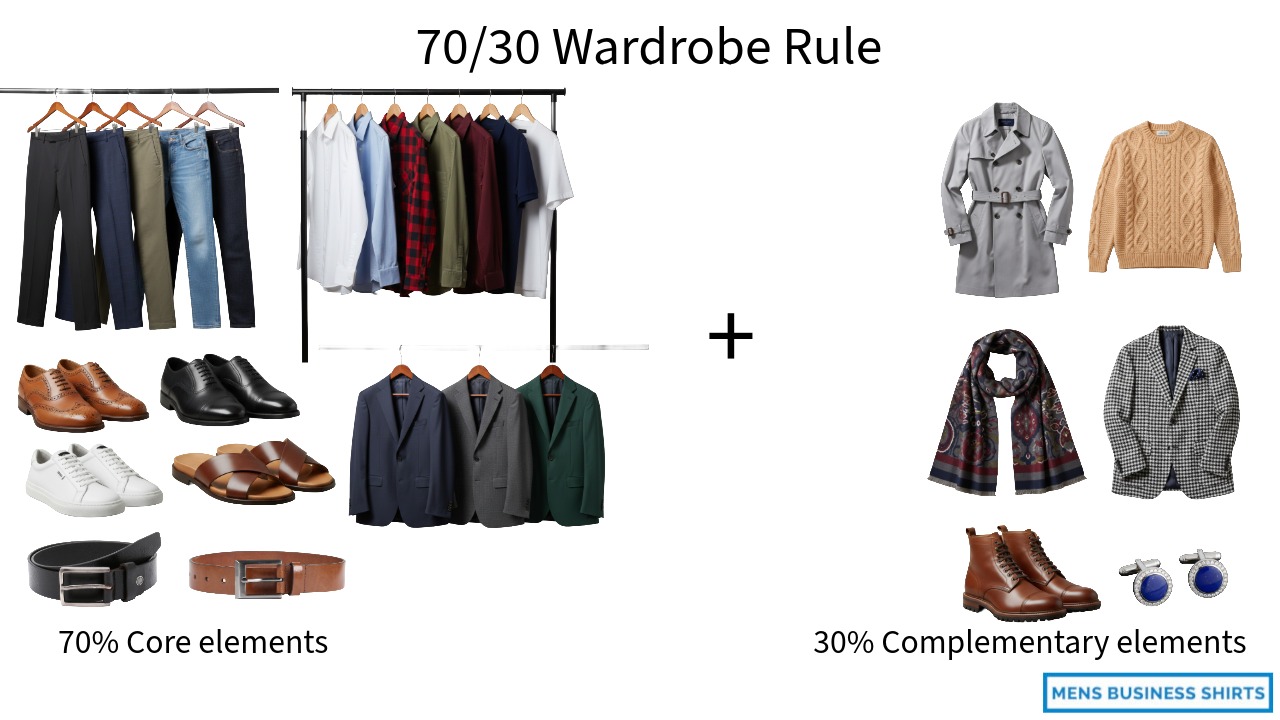
Picture this: You are dressed in a black t-shirt, black jeans, and a black leather jacket (70% neutrals). This pure neutral colour look might look a bit flat. Adding a pair of tan boots and a silver watch (30% accents) can provide a harmonious blend that can instantly elevate your look.
What is the 70/30 rule?
The concept of 70/30 in men’s fashion helps you build a balance between dressing and styling. It aims to distribute 70% of the look on the foundational core elements (dominant element) and the remaining 30% on complementary elements.
The 70% is the framework of your outfit, which has to be chosen wisely by investing in high-quality, timeless pieces like well-tailored suits and blazers, classic white shirts, neutral bottomwear, high-end leather shoes, etc.
The 30% you put in the ensemble helps in showcasing your personality. It is the allotment of the pieces that add character to your foundational core, and they may include:
- Statement Pieces: A leather jacket, a patterned suit, a pair of unique shoes, or any bold accessory.
- The Seasonal Edit: Pieces that are best suited for the ongoing season, like knitted sweaters in winter, flannel overshirts in autumn, and pure linen shirts in summer.
- Palettes and Prints: Bold and vibrant colours, uncommon prints to complement your neutral framework (70%).
- Occasion-based Dressing: Clothing pieces saved to be worn for special events, other than your daily wear clothing.
Rusticsocial has covered this broadly, so you can read.
Advantages of 70/30 Rule:
- Empowers your image: This rule ensures you maintain a well-balanced silhouette with an authoritative base (70%) and perfect allowance for personal expression (30%).
- Eliminates Decision Fatigue: You can avoid the morning guesswork and save your energy for taking high-stake decisions.
5R’s of Fashion
Short Description: Reduce, Reuse, Recycle, Repair, and Repurpose.
Unisex Rule?: Yes
What is the 5R’s rule of fashion?
The 5R’s of fashion are Reduce, Reuse, Recycle, Repair, and Repurpose. It is a simple fashion rule that can help you in getting the most out of the garments present in your wardrobe.
Because of the emerging trends every single day, we invest a lot of money on our garments without thinking about sustainability. Implementing this framework can extend the life of your clothing and also reduce the carbon footprint by promoting a more conscious approach to consumption.
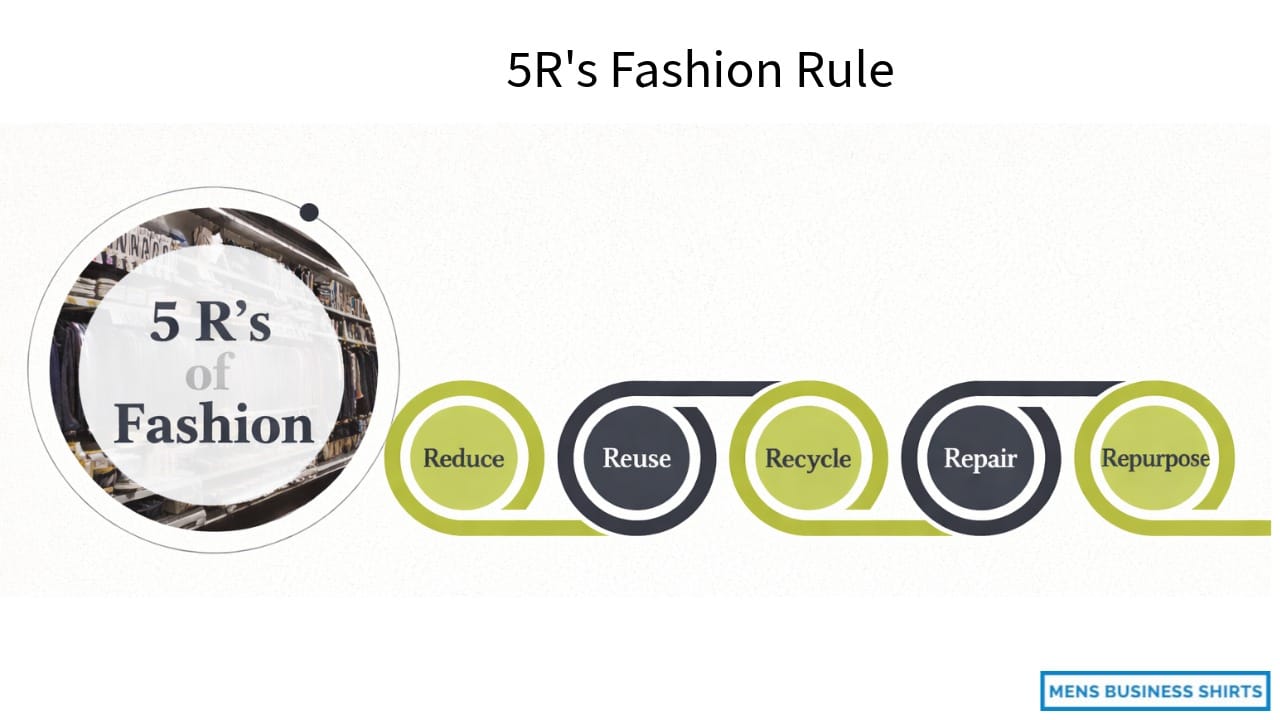
Here is how you can apply the 5R’s fashion rule:
Reduce: Always prioritize quality over quantity. By doing this you can curate a high-performance closet, which can become a sharp, reliable asset for years.
Reuse: It is a good idea to scan your wardrobe before getting yourselves the new ones. By using the 3-3-3 rule, you can discover new outfit combinations and pair them with different accessories for a new look every time.
Recycle: Make it a habit to recycle your old clothes once they are completely worn out through textile recycling so that they add value instead of going to the landfill waste.
Repair: Do not discard clothes that have minor defects. Replacing a broken button, polishing your scuffed shoes, and their proper maintenance can increase the lifespan of your pieces and also add to sustainability, thereby saving the planet.
Repurpose: Sometimes the clothes get stained beyond repair, but the fabric remains good, which can be used for other things. For example, a well-worn pair of denims can be tailored into shorts, thereby ensuring the longevity of every piece in your closet.
Following this rule is not about sacrificing your style; it is about doing your best to minimise the fashion footprint because adhering to these principles will not only make you look good but also feel good.
Pros of this rule:
- By adhering to this rule, you spend less on clothing and invest in better quality.
- When you reuse high-quality pieces, you develop a distinctive look, which makes you different from others.
- By repairing your old clothes, you do not just extend the lifespan but also ensure the item fits you perfectly.
80/20 Rule
In Brief: 80% of outfits come from 20% core clothing.
Unisex rule?: Yes
Picture this: In the morning, you open your wardrobe packed with clothes, but you reach out for the same jeans and a t-shirt. You feel guilty for ignoring the remaining clothes, which are sitting unworn in the closet. Here comes the rule of 80/20, which says to create 80% of the outfits from the 20% core clothing so that you discover a fresh look every time.
Understanding the Rule
The 80/20 wardrobe rule, also called the Pareto principle, advises you to curate 80% new combinations from the 20% foundational pieces. It also suggests that you only wear 20% of your clothes 80% of the time, motivating you to design a wardrobe containing 80% versatile basics with 20% personality items.
The 80/20 wardrobe rule allows you to build a versatile, harmonious closet where every piece is used with confidence and authority. It lets you keep the functional items that you feel comfortable in and get rid of the unused items that are sitting in your wardrobe.
Why does it work well?
- Conscious shopping: The 80/20 wardrobe rule helps you rethink before making a decision to invest in new clothes.
- Helps in decluttering: It helps you declutter the unwanted, excess pieces in your wardrobe, minimising decision fatigue and saving time and money.
10-10-10 Rule
The Gist: Keep the item if it is wearable in 10 years, liked by 10 people, and used for 10 occasions.
Unisex Rule?: Yes
What is the 10-10-10 Rule?
The 10-10-10 rule states that your wardrobe should contain timeless pieces that can last for a decade, are appreciated by 10 people, and can be used for 10 different occasions. This rule is designed to fight the fast-growing fashion trends by evaluating a garment’s value across three dimensions: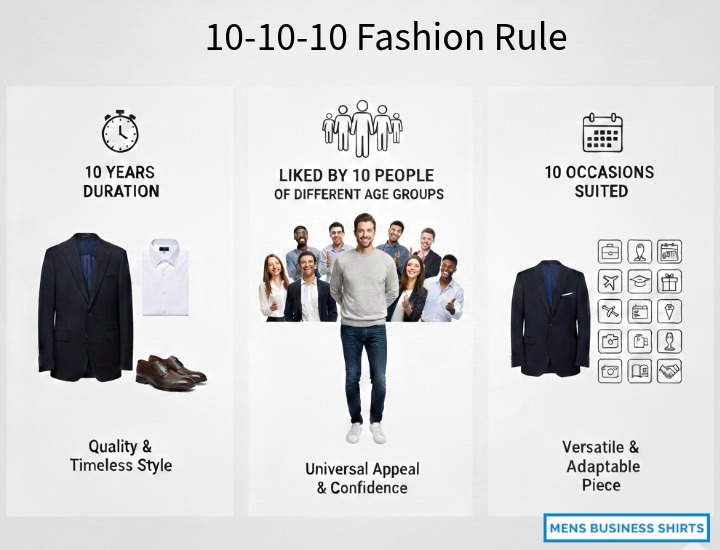
10 Years: Make sure every high-quality garment you buy should last for at least a decade. Going for a timeless style that can be used even after ten years can be a wise decision.
10 People: Always choose an item that has a classic appeal and is accepted or liked by a specific age group. The idea lies in pursuing excellence that doesn’t get affected by the trends.
10 Occasions: The chosen items should be so versatile that they can be worn to 10 different events. The item fails to adhere to the rule if it is specific and works only for a single occasion.
Advantages of the 10-10-10 Rule:
- According to this rule, you once buy items that last for decades, which decreases the cost-per-wear of your item.
- This rule helps in getting rid of the clutter, making you buy fewer things, which in turn makes your closet smaller and more versatile.
Rule of Thirds
Short Description: The entire outfit is divided in ⅓ or ⅔ proportions for a change in the total appearance.
Unisex?: Yes
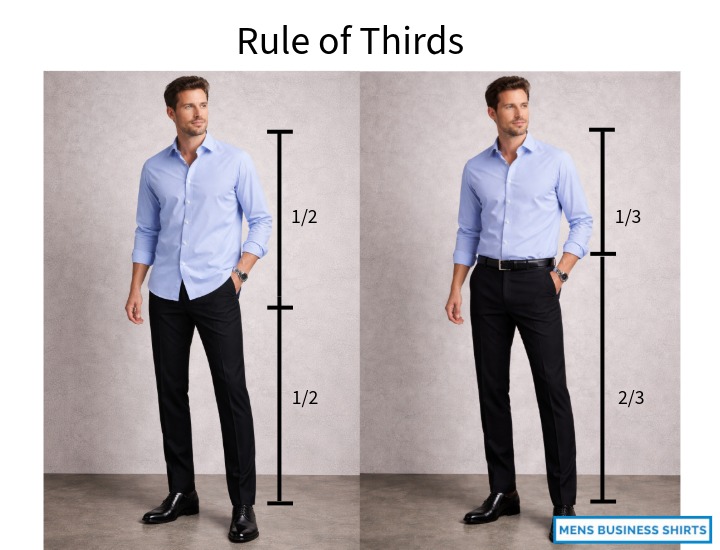
Visualise this: You tuck your t-shirt into high-rise pants, and suddenly you look taller and your legs look leaner. Here, you did not change the clothes; instead, you have changed the proportions. By shifting the visual breakpoint of your outfit away from the middle, you have created a balanced look.
What is the Rule of Thirds?
The rule of thirds is a well-known fashion rule that involves dividing your whole outfit into three parts, either vertically or horizontally. This technique promotes a stable and balanced look without dividing the outfit into two equal halves. For achieving a more flattering look, you need to aim for a 1:2 or 2:1 ratio.
The rule of thirds is a very easy and powerful fashion rule that can change your style game. This rule helps in creating visually appealing looks that can complement your body shape. You can experiment with different outfit combinations to know what looks best on you.
How does this rule help men?
- Elongates the lower portion of the body: By dividing the whole outfit in the ratio 1:2, you make your legs look longer, providing a streamlined look.
- Instantly elevates the look: This rule helps in styling the outfit rather than just wearing it, without adding anything extra.
Third Piece
Brief Description: Add an accessory/clothing item over the top and bottom for polish.
Unisex Rule?: Yes
Picture this: You wear a formal shirt and dress pants to attend a client meeting. It looks fine, clean, and simple. But you add a blazer, and your entire outfit gets transitioned within seconds. In this case, adding a third piece to your outfit has positively transformed its overall appearance.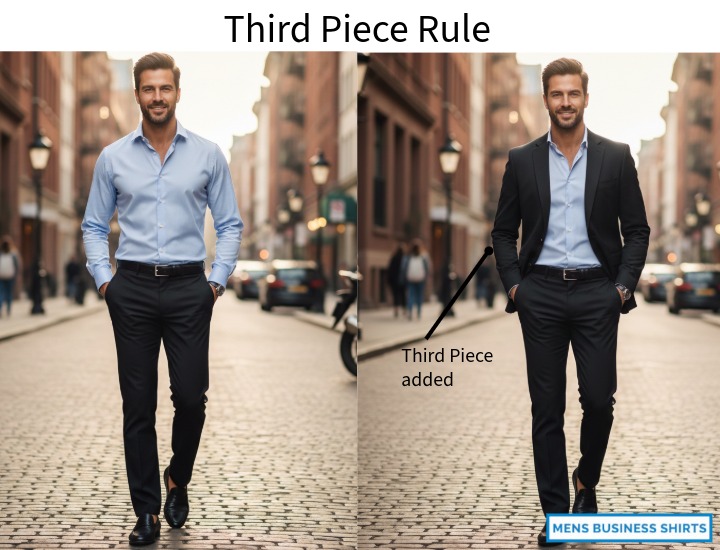
Understanding the rule:
The third piece rule of fashion is a simple rule that states that adding a third piece to your basic outfit can add depth and transform your look straight away, the first piece being the topwear (shirt, t-shirt, or polo) and the second one being the bottomwear (trousers, jeans, or chinos).
But not every third piece has to be a clothing piece; accessories can also do the job.
- A statement belt or a unique pair of shoes can be the talk of the town.
- A premium watch can be the hero accessory if you want a sophisticated vibe.
- A smartly chosen scarf not only keeps you warm but also provides a classy look.
Make sure the third piece you add complements your outfit’s colour and vibe.
Hover over this Man Of Ambition page to know which third piece should be added to your outfit for it to look event-relevant.
Advantages of this rule:
- Adding the third piece to a standard outfit can create a visual interest in your outfit, drawing the attention of the viewer.
- It adds depth and dimension to a basic ensemble, making it appear more wisely crafted.
Fit is King
Short Description: A well-tailored garment is better than an expensive one that doesn’t fit you properly.
Unisex rule?: Yes
Visualise this: You see two people wearing the same outfit, a t-shirt with light wash jeans. One man looks sloppy, and the other looks like a model. The difference is their fit. The first man’s t-shirt and jeans were ill-fitting, while the second guy’s outfit looked perfect for his body shape. That is the power of “Fit is King.”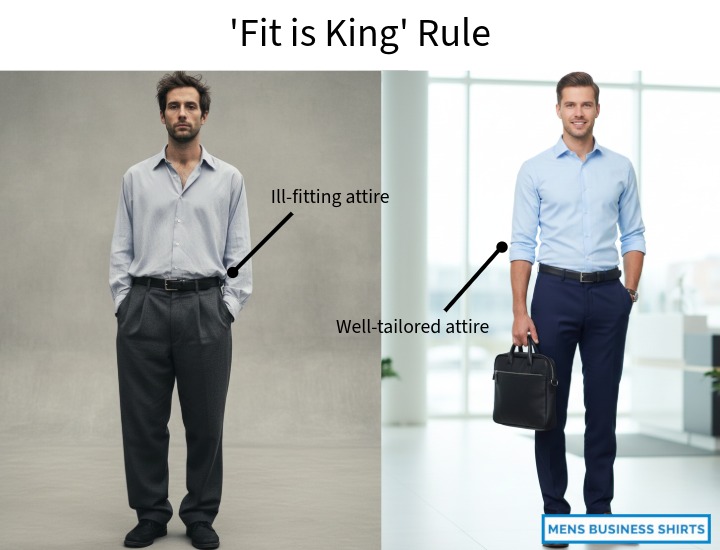
What does the fashion rule “Fit is King” state?
The rule “Fit is King” says you need to prioritise the fit and silhouette of a garment and not its price, colour, or brand. It doesn’t matter how expensive the garment is until and unless it has a good fit.
For a particular clothing item (be it a shirt, a pair of pants, or a suit), there are three areas where the fit is crucial:
- The silhouette: The shirt and trousers should be perfectly tailored. They should not be body-hugging nor excessively baggy.
- The length: If it is a shirt or a suit, the sleeves should end just at the wrist bone. For trousers, the length should match your height and have a break at the fold where the fabric touches the shoe.
- The shoulders: This is one of the most important points to consider when talking about the fit. The seam of the topwear should sit right where your arm and shoulders meet. If it falls down, it is too big, and if the seam pulls, it is too small.
How does this rule benefit men?
- This rule helps you move more effortlessly because you are not constantly adjusting your sleeves or pulling up your pants, thereby increasing the confidence level.
- Even simple, basic clothing pieces look expensive and elegant when tailored to your specific body measurements.
- This rule offers a more balanced and structured look, ensuring your natural body frame is highlighted.
Visit mens shirt size page to learn more about the size guide for men.
Belt-Shoe Match
Brief description: Your belt and shoes in an outfit should be of the same colour to obtain a cohesive look.
Unisex Rule?: Mostly men
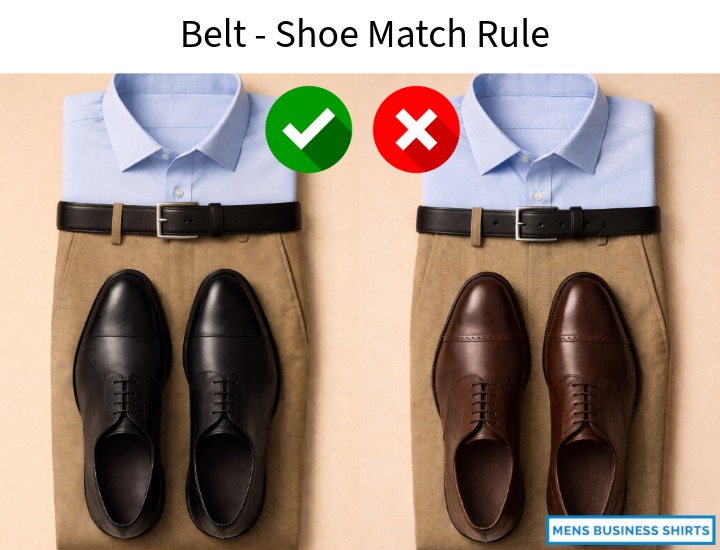
Picture this: You wear a white shirt with a navy suit to attend a wedding. You have accessorised the outfit with a black leather belt and a pair of brown brogues. By replacing the black belt with a brown one that matches your brogues, the whole attire looks coordinated.
Understanding the rule
The belt-shoe match fashion rule is one of the simple fashion rules that states both the belt and shoes act as focal points of an outfit and should be in symmetry with each other for the whole ensemble to look synchronised.
A human eye naturally finds it appealing when both the belt and shoe are in sync, as they are present in the same vertical line of sight. Though this rule is about the colour, texture, and pattern, the main aim is coordination.
- This rule is strictly restricted to leather accessories. If you have chosen black leather shoes with your outfit, then the belt should also be black leather.
- You do not always need to match the exact colour, but a slightly different shade also works well. For example, brown shoes work best with belts in similar shades of brown (but not too different).
- Matching the texture of the belt-shoe combination is also important. Pairing matte-finish dress shoes with a sleek matte belt can give a proportioned look.
Why does it work well?
In formal, or black tie settings, a shoe-belt match is the sign of a well-dressed man. It shows you have a good grip of fashion rules.
By matching your belt with your shoes, you avoid including multiple colours into your outfit, thereby creating a tidy, streamlined silhouette.
Socks-Pants Rule
Short description: Match your socks with the pants for leg line harmony.
Unisex Rule?: Mostly men
Picture this: You are getting ready for a formal event and you have dressed up in a grey suit with black shoes and white socks. When you sit down, your trousers rise up and your bright white socks are visible. The white colour of the socks breaks the long line of your leg, making your outfit look mismatched. Instead of those white socks, if you had worn socks that matched the colour of your suit, the outfit would have remained uninterrupted.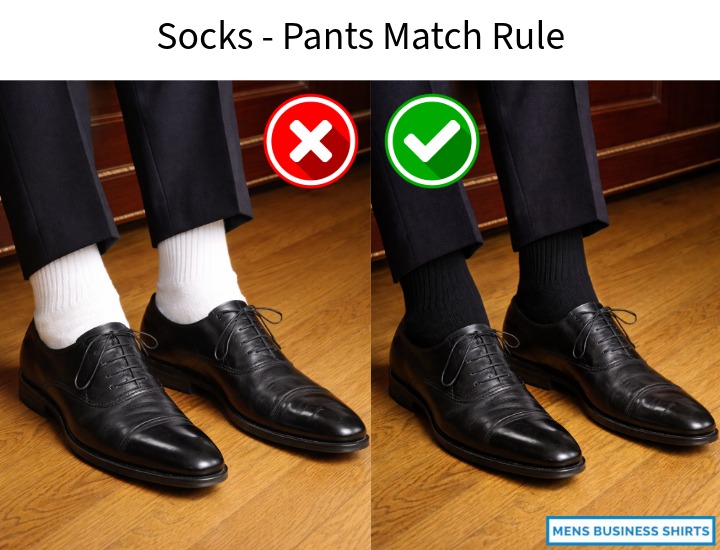
What is the rule of the Socks-Pants match for men?
The socks-pants match rule for men, often known as the “Vertical line rule“, is a fashion rule that helps in extending the visual line of your leg. It states that matching the socks with your trousers can make you look taller and more sophisticated.
While many men consider socks as a tiny detail, this little clothing item can completely change how polished your ensemble looks. There are a few things to be kept in mind while following this rule:
Always match your socks with the pants, not the shoes. This creates a continuous vertical line from the waist to the foot, making you look elevated.
- For classic events, go for dark solid colour socks, as they pair effortlessly with formal wear.
- The ideal socks length for formal events is mid-calf, so that they stay in place throughout the day.
- Prioritize the fit, fabric, and colours over the cheap ones that lose shape after the first use.
Power of Socks-Pants Match Rule:
- Timeless elegance: This rule helps in creating a smooth, clean look from the waist to the foot.
- Effortless styling: Just like the belt-shoe match rule, this rule helps you get rid of the morning fatigue by giving you a clear formula of matching your socks with the pants.
Design Rules Table
| Rule | Unisex? | Key Application |
|---|---|---|
| 3-3-3 Rule | Yes | Capsule wardrobe: 3 tops, 3 bottoms, 3 shoes for 27 outfits |
| 7 Rule for Outfits | Yes | An outfit must contain only seven distinct items |
| 70/30 Rule | Yes | 70% neutrals + 30% accents for balance |
| 5 R’s of Fashion | Yes | Reduce, Reuse, Recycle, Repair, Repurpose |
| 80/20 Rule (Wardrobe) | Yes | 80% outfits from 20% core clothes |
| 10-10-10 Rule | Yes | Keep if wearable in 10 years/10 people/10 occasions |
| Rule of Thirds | Yes | Proportions via ⅓-⅔ outfit divisions |
| Third Piece | Yes | Add jacket/scarf over top+bottom for polish |
| Fit is King | Yes | Tailoring > trends for 90% style impact |
| Belt-Shoe Match | Mostly men | Coordinate leather colours/materials |
| Socks-Pants | Mostly men | Match socks to pants for leg line harmony |
FAQs
Here is the updated FAQ with the first two entries replaced and the additional related 3-3-3 questions included, followed by the rest of the original FAQs:
It's a capsule wardrobe of 3 tops, 3 bottoms, and 3 pairs of shoes, chosen to cross-match rather than pair with just one outfit. Nine pieces, up to 27 combinations.
Choose 3 business-appropriate shirts, 3 trousers, and 3 pairs of shoes in a cohesive palette, then rotate them. The same combinations that work casually shift formal with the right pieces.
Yes. The same three categories apply. Some people add dresses or skirts as a fourth category, but the core method doesn't change by gender.
Not in the original version. The 3-3-3-3 variation adds them as a fourth category for people who want more room to personalise.
Yes. Nine pieces that all cross-match will get you further than double that number chosen without a plan, and it's the same logic that makes the method work at home.
A capsule wardrobe is the broader idea: a small, versatile clothing collection. The 3-3-3 rule is one specific way to build one, using a fixed count of tops, bottoms, and shoes.
No fixed schedule. Replace pieces when they wear out, stop fitting, or stop suiting the current routine, not on a set timeline.
This rule provides a balanced, planned look by adding only seven items in your total outfit, including accessories. It helps you limit the use of extra pieces so that your ensemble doesn’t look fussy and stuffed.
It reduces decision fatigue and clutter by forcing you to use only 7 items in your outfit that all work together. You look more consistent and polished day to day.
The 70/30 rule suggests that roughly 70% of your wardrobe should be timeless basics and 30% more expressive or trend-driven pieces. This keeps outfits grounded but still interesting.
Make most shirts classic colours and patterns for work, then use a smaller portion for bolder colours, textures or casual styles. You stay office-appropriate without looking boring.
They typically stand for reduce, reuse, recycle, repair, and repurpose, encouraging more responsible wardrobe decisions. This mindset limits waste while improving the quality of what you own.
Buy fewer but better shirts, rewear them in more combinations, repair minor damage, pass on what you no longer use, and recycle worn-out ones. You save money and dress better over time.
The 80/20 rule says most people wear about 20% of their clothes 80% of the time. It highlights that a small part of your wardrobe does most of the work.
Identify the shirts, trousers and shoes you reach for most, then build around them and stop buying items you rarely wear. This leads to a more focused, high-performing wardrobe.
It is a mindset tool: Ask yourselves whether the outfit you purchase will last for 10 years, be liked by 10 different age groups, and be used on 10 different occasions.
If a shirt will not feel right beyond the short-term fit, quality or style, then skip it. You end up with more timeless, better-fitting pieces you are happy to wear for years.
The rule of thirds is a proportion guideline where your outfit is visually split into roughly one-third and two-thirds instead of halves. This creates a more flattering, dynamic look.
Aim for your trousers to visually take about two-thirds of the vertical space and your upper body one-third, or vice versa with layering. Proper rise and jacket length are key.
It means adding one extra item beyond your basic shirt and pants, like a blazer, knit, vest or tie, to instantly make the outfit look more intentional and complete.
Common options include a sport coat, cardigan, vest, tie, pocket square or even a sharp belt. The third piece adds depth, texture and personality without much effort.
Because even an inexpensive shirt looks far better when it fits your shoulders, chest and sleeve length properly, while a pricey piece looks bad if the fit is off. Fit matters more than brand.
The shoulder seam should sit at your shoulder edge, the collar should allow two fingers when closed, and buttons should not pull. Excess billowing or tightness means a different size or fit.
The classic rule is to match your belt to your shoes in both colour and general finish, especially for dress or business outfits. This small detail makes the look more cohesive.
In more casual outfits, you can relax the rule slightly, but the belt should still harmonise with your footwear and overall colour palette rather than clash.
The usual guideline is to match your socks to your trousers rather than your shoes, creating a clean visual line and avoiding a stark break at the ankle when you sit.
Subtle patterns and colours that still relate to your trousers or tie can work in many offices, but in conservative settings stick to darker, tonal socks that blend with your pants. What is the 3-3-3 rule in men's fashion?
How do I use the 3-3-3 rule for work outfits?
Does the 3-3-3 rule work for women too?
Do accessories count in the 3-3-3 rule?
Is the 3-3-3 rule good for travel packing?
How is the 3-3-3 rule different to a general capsule wardrobe?
How often should a 3-3-3 wardrobe be refreshed?
What is the 7 rule for outfits?
Why is the 7 rule helpful for men’s style?
What is the 70/30 fashion rule?
How do I apply the 70/30 rule to business shirts?
What are the 5R’s of fashion?
How do the 5R’s apply to men’s business shirts?
What is the 80/20 rule in style?
How can I use the 80/20 rule to improve my wardrobe?
What is the 10-10-10 rule in fashion decisions?
How does the 10-10-10 rule help with buying shirts?
What is the rule of thirds in men’s outfits?
How do I use the rule of thirds with shirts and trousers?
What is the third piece rule?
What counts as a good third piece for men?
Why do people say 'fit is king' in men’s style?
How do I know if a business shirt fits correctly?
What is the belt-shoe match rule?
Can I ever break the belt-shoe match rule?
What is the socks-pants rule?
Are statement socks OK with business shirts and suits?
